
Are Natural Male Supplements Heart Safe? A 2026 Guide
Sep 23rd 2026
Table of Contents
- Why Men Ask If Male Supplements Are Heart Safe
- How FDA Supplement Safety Regulations Work
- Common Male Enhancement Supplement Side Effects
- Herbal Supplement Drug Interactions You Need to Know
- Ingredients That May Threaten Heart Health
- How to Verify Third-Party Testing and Label Transparency
- Conclusion
- Frequently Asked Questions
Last Updated: September 23, 2026
Why Men Ask If Male Supplements Are Heart Safe
The question "are natural male supplements heart safe" comes up for one simple reason: the word "natural" does not automatically mean "safe for your heart." A 62-year-old taking blood pressure medication who adds an herbal capsule to his morning routine is running a combination nobody has tested on him specifically.
This guide walks through what the FDA actually regulates, which ingredients carry real cardiovascular risk, and how to check a label before you swallow anything.
Here is the part most guides get wrong: they treat "natural" and "pharmaceutical" as opposites, when in fact many prescription heart drugs were derived from plants. The distinction that matters is not natural versus synthetic. It is tested versus untested, and disclosed versus hidden.
How FDA Supplement Safety Regulations Work
FDA supplement safety regulations treat dietary supplements as a category of food, not drugs. That single classification explains almost everything about how these products reach the shelf.
Under the current framework, manufacturers do not need FDA approval before selling a supplement (the FDA). They are responsible for ensuring their own products are safe, and the FDA can act only after a problem surfaces. The agency can issue warnings, seize products, or force a recall, but none of that happens before your first bottle ships.
What this means in practice:
- No pre-market testing for effectiveness
- No required proof that the label matches the contents
- No mandatory reporting of adverse effects to the FDA
- Enforcement triggered by complaints, inspections, or hospital reports
The FDA publishes guidance and warning letters on its own site, and those letters are worth reading if a specific ingredient concerns you. The FDA dietary supplement guidance explains the current rules in plain terms.
Common Male Enhancement Supplement Side Effects
Most reported male enhancement supplement side effects are mild: digestive upset, headache, flushing, or a temporary drop in blood pressure. The serious ones tend to involve the cardiovascular system, and they usually appear when an ingredient is taken at a dose far above what the label suggests.
A common mistake is assuming that a smaller dose is always safer. With certain stimulant-type botanicals, the opposite can be true for a man with an existing heart rhythm issue.
Watch for these signals and stop use if they appear:
- Chest tightness, palpitations, or a racing pulse
- Sudden headache with visual changes
- Dizziness on standing
- Unusual shortness of breath during light activity
These are not proof that a supplement caused the problem. They are reasons to stop and call a physician, not reasons to wait and see.
Herbal Supplement Drug Interactions You Need to Know
Herbal supplement drug interactions are the single most under-reported risk in this category, and the reason is structural: most men never tell their doctor what they are taking, and most doctors do not ask. A 2023 survey pattern that shows up repeatedly in clinical literature is that a majority of supplement users do not disclose use to their physician, which means the interaction was never screened for in the first place.
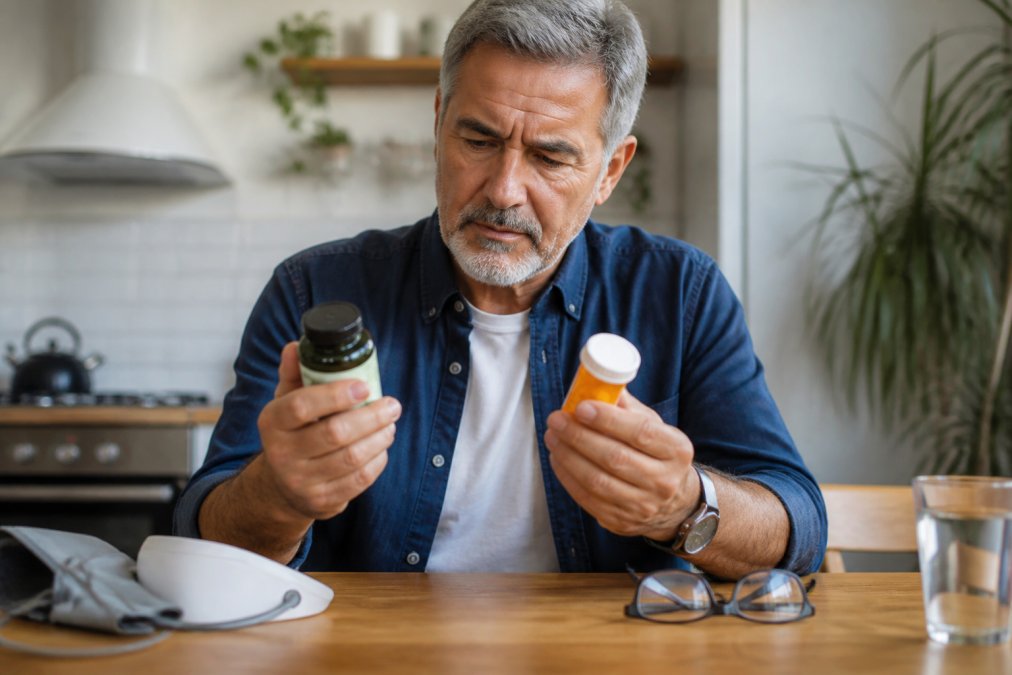
There are two mechanisms that drive most of these interactions, and understanding them makes the risk predictable.
Mechanism 1: Liver enzyme competition. Many botanicals are metabolized by the same cytochrome P450 enzymes that process prescription drugs. When a supplement and a medication compete for the same enzyme, the medication can build up in the blood (raising side-effect risk) or be cleared too quickly (losing effectiveness). St. John's Wort is the best-documented example, it induces CYP3A4 and can reduce the effectiveness of dozens of drugs, including some blood pressure medications and statins. Ginkgo, garlic, and ginseng have all been implicated in similar patterns.
Mechanism 2: Additive pharmacological effect. This is the one that matters most for male supplements. If a supplement widens blood vessels and your prescription also widens blood vessels, the effects add. If a supplement thins the blood and your prescription also thins the blood, the effects add. The interaction is not chemical, it is arithmetic.
The drug classes where this arithmetic gets dangerous:
- Nitrates (nitroglycerin, isosorbide), combined with vasodilating supplements, can cause a severe blood pressure drop
- PDE5 inhibitors (sildenafil, tadalafil), same vasodilation concern, and a known risk when stacked with "natural" erectile products that contain hidden PDE5 inhibitors
- Blood thinners (warfarin, apixaban, rivaroxaban, clopidogrel, daily aspirin), combined with ginkgo, garlic, or ginseng, can increase bleeding risk
- Blood pressure medications (ACE inhibitors, ARBs, beta-blockers, calcium channel blockers), combined with vasodilators or stimulants, can push pressure too low or too high
- Alpha-blockers (tamsulosin, doxazosin), commonly prescribed for prostate symptoms in men over 50, and a frequent interaction partner with vasodilating supplements
Pre-Existing Condition Screening Checklist
Before you start any male supplement, run through this list. If you answer yes to any item, get a physician's sign-off first, not a pharmacist's, not a friend's, a physician who knows your full medication list.
- Do you take any prescription medication for blood pressure, cholesterol, blood sugar, or heart rhythm?
- Do you take a blood thinner, including daily aspirin?
- Do you have a history of arrhythmia, atrial fibrillation, or palpitations?
- Do you have high blood pressure that is not well controlled?
- Do you have kidney or liver disease?
- Do you have diabetes or prediabetes?
- Do you have a family history of heart attack, stroke, or sudden cardiac death before age 60?
- Are you over 50 and taking an alpha-blocker for prostate symptoms?
- Have you ever had chest pain, shortness of breath on exertion, or fainting?
- Are you taking any other supplement, including a multivitamin or protein powder?
If you answered no to every item, you still need to read the label, but your baseline risk is lower. If you answered yes to even one, the conversation with your physician is not optional.
The honest framing is this: the interaction risk is not hypothetical, it is predictable. The mechanisms are known, the drug classes are known, and the screening questions are known. The only variable is whether you do the screening before you start or after something goes wrong.
Ingredients That May Threaten Heart Health
Generic warnings about "stimulants" and "vasodilators" do not help a man standing in a store aisle holding a bottle.
Nitric oxide precursors and vasodilators. L-arginine, L-citrulline, and beetroot extract are the workhorses of "pump" and erectile-support formulas. They work by raising nitric oxide, which relaxes blood vessel walls. That is the intended effect, and it is also why they can compound the blood-pressure-lowering action of nitrates, alpha-blockers, or PDE5 inhibitors. A man on any of those who adds a high-dose arginine product is stacking vasodilation on vasodilation, and the result can be a symptomatic pressure drop: lightheadedness, fainting, or a fall.
How to Verify Third-Party Testing and Label Transparency
Third-party certification means an independent lab, not the manufacturer, verified what is in the bottle. That is the whole value: it removes the fox from the henhouse.
Here is what to check, in order:
| What to Check | Why It Matters | Red Flag |
|---|---|---|
| Full ingredient panel with amounts | Lets your physician screen for interactions | "Proprietary blend" with no quantities |
| Third-party lab certification | Confirms label matches contents | No testing claim anywhere |
| Manufacturing facility disclosure | Indicates basic quality control | No facility information |
| Batch or lot number | Enables tracing if a problem arises | No lot number on the bottle |
| Clear contact and return policy | Shows accountability | No way to reach the seller |
The two things that separate a credible supplement from a risky one are a fully disclosed label and independent testing. If either is missing, you are the test subject.
Conclusion
The honest answer is that heart safety depends far less on the word "natural" and far more on what is actually in the bottle, how much of it, and what else you take. No supplement replaces a physician conversation, especially if you manage blood pressure, take a prescription, or have a family history of heart disease.
Get started with LibertyNorth and add to cart.
Frequently Asked Questions
Do cardiologists recommend male enhancement supplements?
Most cardiologists do not recommend them without a conversation first. Many male supplements contain ingredients that raise blood pressure, affect heart rhythm, or interact with prescription drugs. If you have a heart condition or take medication, bring the product label to your physician before starting. A doctor can review the ingredient list against your current prescriptions and flag anything that poses a risk to your cardiovascular health.
Can natural supplements interact with blood pressure medication?
Yes. Herbal supplement drug interactions are common with blood pressure medications. Ingredients like yohimbine can raise blood pressure and counteract beta-blockers or ACE inhibitors. Others, including ginkgo and ginseng, may thin the blood or alter how your body processes prescriptions. Always tell your doctor about every supplement you take, even natural ones, so they can check for contraindications and adjust your care plan accordingly.
Are herbal male enhancement pills regulated by the FDA?
No. Under FDA supplement safety regulations, dietary supplements are treated as food, not drugs. They do not need pre-market approval for safety or effectiveness before they are sold. The FDA can act after a product reaches the market if it proves unsafe or makes illegal claims, but that is reactive. This means label accuracy, ingredient purity, and dose consistency depend largely on the manufacturer, which is why third-party certification matters.
What are the signs that a supplement is affecting your heart health?
Watch for chest pain, shortness of breath, heart palpitations, a racing or irregular heartbeat, sudden dizziness, or swelling in your legs and ankles. A rise in blood pressure readings is another warning sign. If any of these appear after starting a male supplement, stop taking it and contact your doctor. Do not wait to see if symptoms pass, because some adverse effects on heart rhythm and blood pressure can become serious quickly.